
Starved at a Full Table

For most of my life, I thought of supplements as a gap-filler: the last ten percent you added once the real work of eating well was done. Eat clean, sleep well, move your body, and maybe top it off with a little something in a capsule. I've changed my mind and this post will walk you through why.
None of this will surprise you if you've read my earlier pieces on soil health, your food's hidden journey, and food as medicine. I've spent a lot of words making the case that our food isn't what it used to be. Our soils are depleted, our produce is harvested early and shipped far, and much of what fills the grocery store is engineered for shelf life rather than vitality. I stand by every bit of it. Eat the real, whole, colorful, regeneratively grown food; it's the foundation everything else is built on.
But here's the turn: I no longer believe that food alone can fully feed the body. Not because you're doing it wrong, and not because the food is worthless, but because the modern food industry has quietly changed the food itself underneath us.
Your cells aren't just listening. They're building.
In the first post of this series, I wrote that your cells are always listening; that they build receptor infrastructure around whatever signal they hear most. Here's the other half of that truth: your cells are also always building, and building requires materials.
Every second, your body is running millions of tiny jobs behind the scenes: making energy, repairing itself, clearing out waste, building hormones. Almost none of those jobs happen on their own. Each one needs a specific vitamin, mineral, or essential amino acid to show up and flip the switch; think of them as the spark plugs that let the engine turn over. Magnesium alone is the spark plug for more than 300 different jobs in the body. Take the mineral away and the job slows down or just doesn't happen. Now picture that across thousands of little jobs at once, and you get something that rarely shows up on a standard blood panel; just a body running a little dimmer than it should. Tired. Foggy. Inflamed. Not broken; under-supplied.
That's the mechanism underneath a single word: malnourished.
Malnourished means more than you think

When you hear "malnourished," you probably picture an empty plate — and that's one version of it. But there's another that hides in plain sight: you can eat three full meals a day and still be starving at the cellular level. Researchers call it hidden hunger: plenty of calories, not enough of the nutrients your cells actually need. The modern diet is almost designed to produce it — boxed, bagged, and shelf-stable foods that are rich in energy and stripped of nourishment.
Here's the part that really got me. Much of what fills those boxes is "enriched" or "fortified," nutrients added back after processing stripped them out, so the label reads healthy even when the food isn't. You can be overfed and undernourished at the same time; a full plate, an empty tank.
This is exactly why I push so hard for organic, regeneratively grown produce and regeneratively raised animals; grown in living soil, that food carries more of what your body is looking for. But even the best of it isn't fully immune. The same breeding-for-yield and atmospheric shifts touch the whole food supply, so today's produce, at every tier, tends to carry somewhat less than it did a generation ago. Regenerative likely narrows the gap; it doesn't erase the era we're growing in. One widely cited analysis of USDA data across dozens of garden crops found measurable declines in minerals, protein, and vitamins between 1950 and 1999, driven mainly by breeding plants for size and yield rather than nutrition, with depleted soils compounding it. The carrot still counts. It's just not the same carrot your grandmother ate.
And the produce aisle plays tricks of its own now: a vertical-farm green can be vivid and gorgeous yet only as nourishing as the formula it was fed, and a package stamped "bioengineered" isn't always what it appears. And the way a crop is protected in the field can cost us on the plate. When researchers sprayed strawberries with two fungicides commonly used on the crop, the berries came back less sweet, lower in nutrients, and muted in flavor; the chemicals had interfered with the fruit's own chemistry, not just its surface. It was a narrow study, one fruit and two compounds, but it points at something worth paying attention to. Color and a clean label are not proof of nourishment.
Not all supplements are speaking your body's language
This is where it gets personal for me, and where I'll encourage you to start asking questions about yourself.
If a synthetic nutrient can fall short in fortified food, the same is true in a supplement. The form matters as much as the dose. Whole-food-derived nutrients arrive in the shape your body recognizes, alongside the cofactors nature packaged them with. Many synthetic nutrients arrive as something your body first has to convert, and some of us are not efficient converters.
Take folate, the B vitamin in leafy greens. In real food it shows up ready to use, like an ingredient that's already been washed and chopped. The synthetic version on most labels, folic acid, shows up raw, so your body has to do the prep work to turn it into the form it can actually use — what you'll see called the "active" or "methylated" form. For a lot of people, that prep line runs slow, and the unprepped folic acid just backs up in the bloodstream with nowhere to go. It's why the better supplements skip the step and hand your body the already-prepped version.
Which raises a fair question: why not skip the capsule and just eat the salad? In a healthier food system, you could — greens are exactly where folate is meant to come from. But that's not the food system we have. By the time those greens reach your plate — depleted, shipped, and then cooked down — they carry a fraction of what they should, and some bodies need more still. The supplement isn't replacing the salad; it's covering what our food system quietly stripped out of it.
This isn't abstract for me. Over a decade ago I found out I carry an MTHFR mutation. A common genetic variant that makes me a slow converter of the very folate we're talking about. My doctor told me to start slow, and she warned me to watch for anxiety as a sign of over-methylating. I've never really been an anxious person, so when my migraines started climbing in both frequency and intensity, it didn't register because I was watching for the wrong signal; anxiety, which never came. It took me a while to connect the dots. Once I did, I stopped, went back to the science to actually understand what was happening in my body, and started over. Slowly, breaking the capsule open and pouring out half until I found the amount that felt right. I still take half a capsule today. The right dose wasn't a number a lab handed me; I found it by how my body answered. I still get migraines; I just stopped getting those ones. Finding the right nutrient, in the right form, at the right dose for me wasn't optional; it was the difference between being nourished with a migraine in tow and being nourished, full stop.
Your body has its own version of this story, and most people never go looking for it. What can't you convert well? What do you need more of than the label assumes? Those aren't questions a cereal box can answer.
How to choose without losing your mind
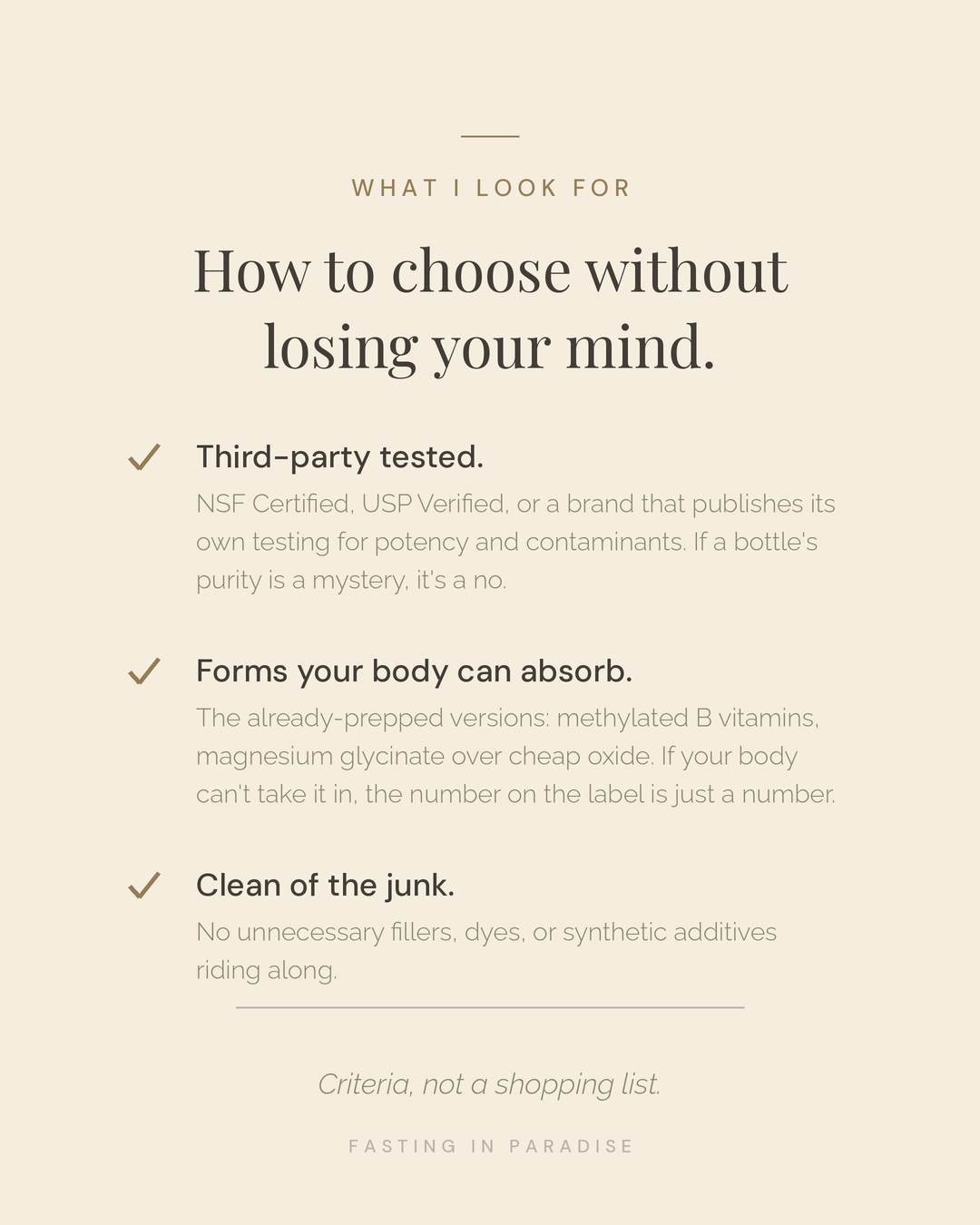
So how do you buy a supplement you can actually trust? I'm not loyal to a single brand; I stay loyal to a set of standards. And here's what I look for:
● Third-party tested. Independent verification. Seals like NSF Certified or USP Verified, or a company that publishes its own testing for potency and contaminants like heavy metals. If a bottle's purity is a mystery, it's a no.
● Forms your body can actually absorb. The "already-prepped" versions like methylated B vitamins, gentler mineral forms like magnesium glycinate instead of the cheap magnesium oxide, whole-food-derived where it counts. If your body can't take it in, the number on the label is just a number.
● Clean of the junk. No unnecessary fillers, dyes, or synthetic additives riding along.
Notice I'm giving you criteria, not a shopping list. The right brand is the one that meets the standard and several do.
You don't need all of them
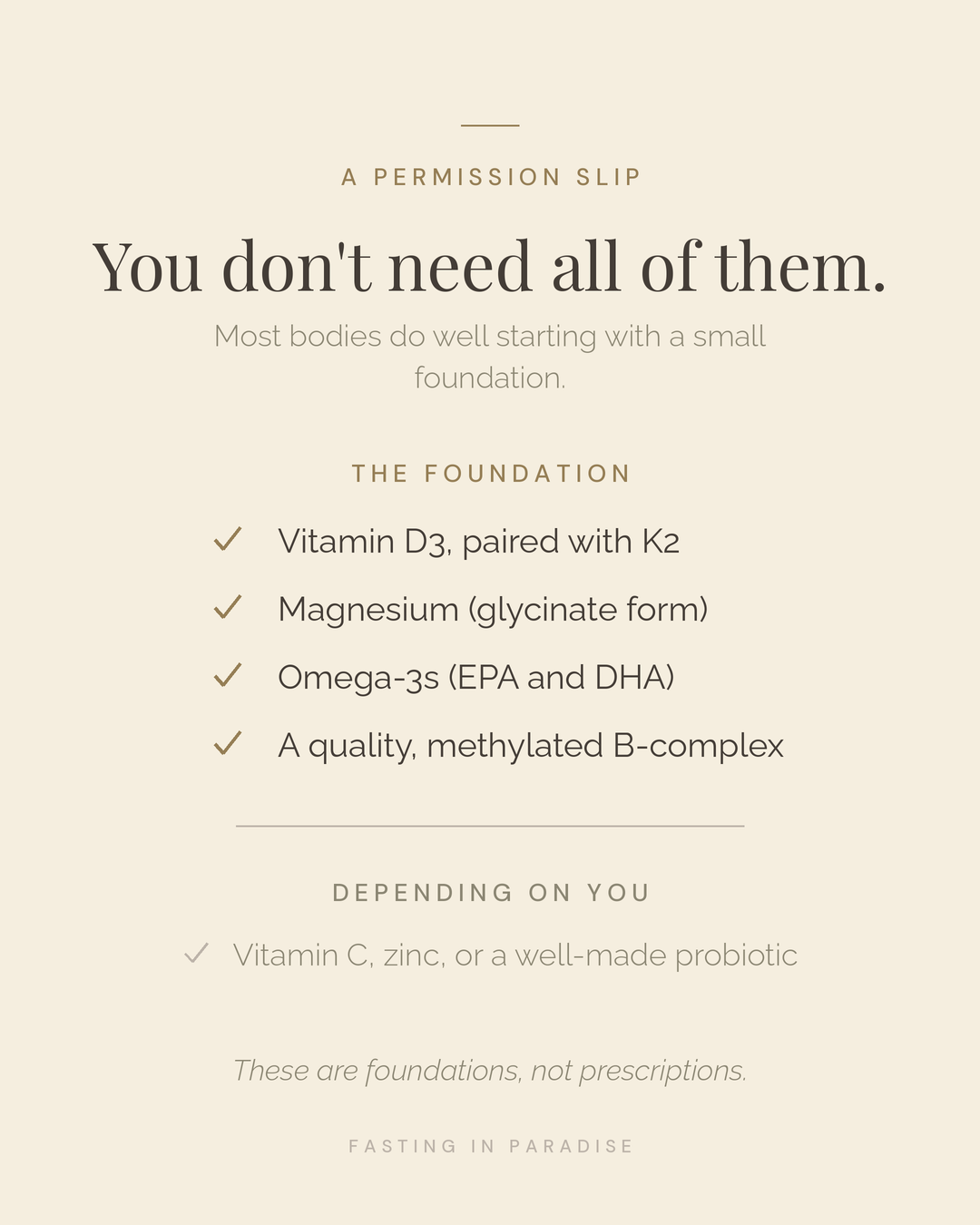
Here's a permission slip: you do not need to take everything. Walk into any supplement store and the sheer wall of bottles is enough to make you quit before you start. That overwhelm is its own kind of stress, which (if you read the first post) your cells are listening to as well.
Most bodies today do well starting with a small foundation:
● Vitamin D3, paired with K2
● Magnesium (I like the glycinate form)
● Omega-3s (EPA and DHA)
● A quality, methylated B-complex
● and, depending on you, vitamin C, zinc, or a well-made probiotic
I say "depending on you" on purpose. I've written before about bio-individuality: the truth that no single protocol fits every body. These are foundations, not prescriptions. The real answer comes from paying attention, and ideally from testing rather than guessing, so you're supplementing what you actually lack instead of what social media is selling this week. And if you're managing a health condition or taking medication, loop in an Integrative Health Practitioner who knows your whole picture before you add anything. None of this is medical advice; it's an invitation to get curious and then get guidance.
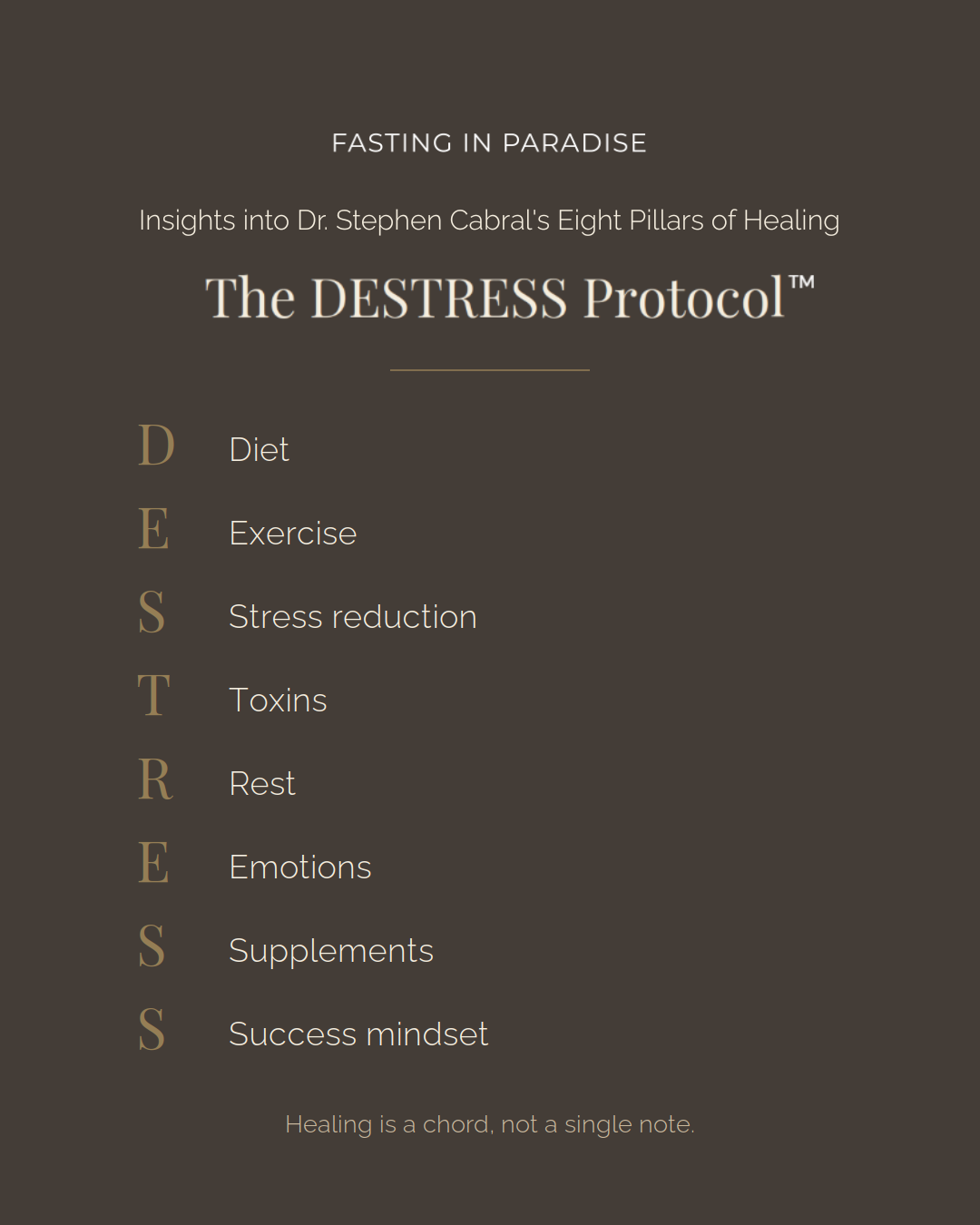
Supplements were the last pillar I made peace with, and now I consider them non-negotiable. Not as a replacement for real food, but as the honest acknowledgment that real food, in this era, needs backup. Supplements are just one piece of Dr. Stephen Cabral's DESTRESS Protocol™, the framework I learned through his Integrative Health Practitioner training and write about here through my own lens. Feed your cells the raw materials, in forms they can actually use, and you give every other pillar something solid to stand on.
Next in the series, we move from what you put in your body to what you carry in it: Emotions. The ones we metabolize, and the ones we don't.
*The DESTRESS Protocol™ referenced in this series was developed by Dr. Stephen Cabral and is taught in his Integrative Health Practitioner certification. I'm grateful for his work, and for training that gives practitioners real tools to help others heal. The interpretations and applications here are my own.