
Success Is a Frequency Your Cells Can Hear
When I say “success mindset,” I want to be clear about which success I mean.
Not the one on the magazine covers. Not the C-level title, the corner office, the seven-figure exit. Those things are great; they’re just not what I’m pointing at. The success I care about and the one I think most of us are quietly aching for underneath the noise is: Peace. Joy. Contentment. Connection. The kind of success you feel in your nervous system before you can name it in words.
That distinction matters, because every cell in your body is listening to which one you’re chasing.
The framework, and why I’m starting at the end
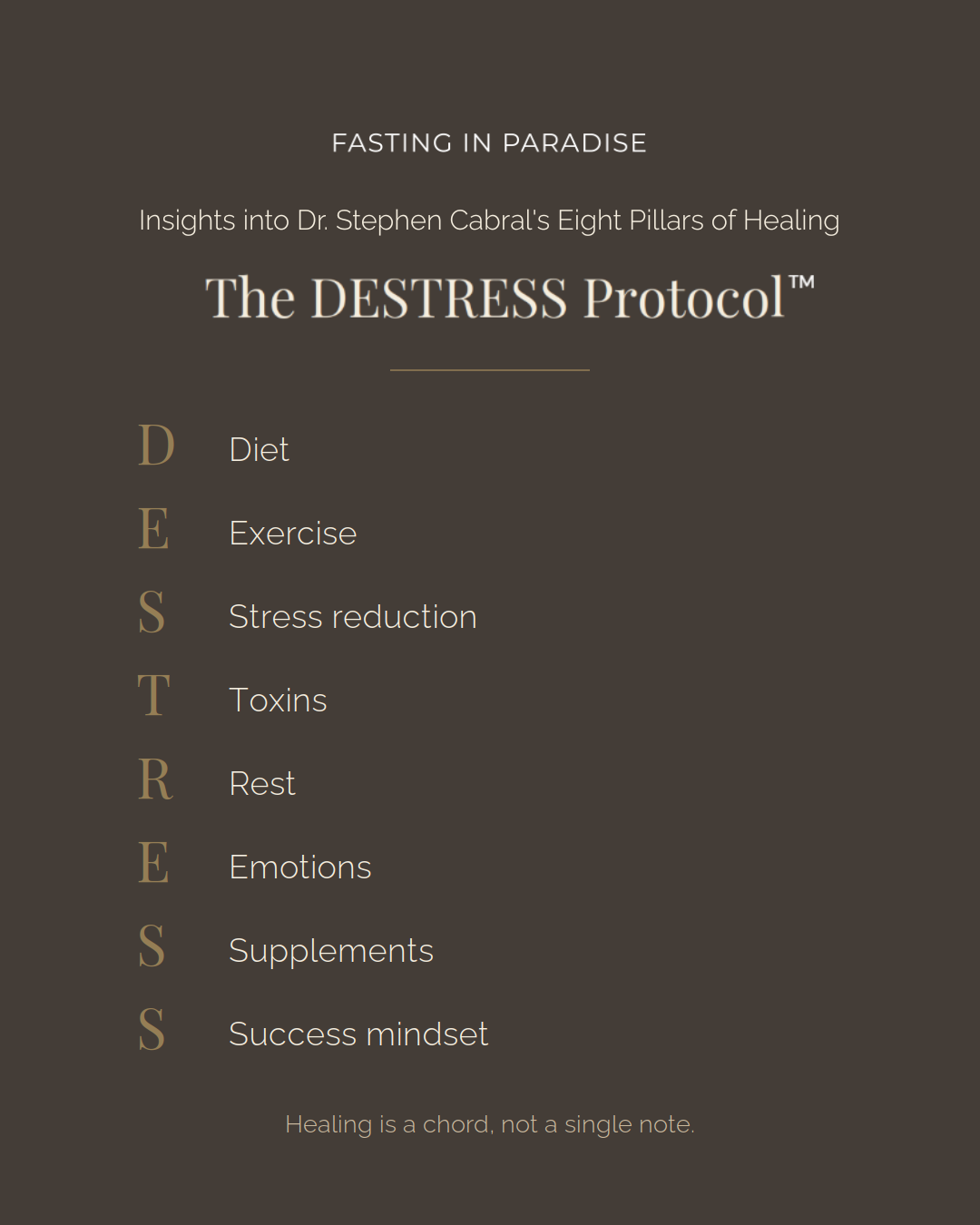
This post is the first in a series I’m building around the DESTRESS Protocol™, taught by Dr. Stephen Cabral as part of his Integrative Health Practitioner training. He teaches it as a clinical protocol; I use the eight pillars as a framework for how I think and write about healing, bringing my own lens to each one across this series. The acronym maps them: Diet, Exercise, Stress reduction, Toxins, Rest, Emotions, Supplements, and Success mindset. I went through Levels I and II of his program, and I keep coming back to it because it refuses to let any one pillar carry the whole weight. You can eat impeccably and still be inflamed; you can sleep eight hours and still be exhausted. Healing is a chord, not a single note.
I’m starting at the end because I believe that a success mindset is foundational to the others. Not more important — the framework refuses to let any single pillar carry the whole weight — but foundational in the way soil is foundational to a garden. The state your nervous system is broadcasting shapes how your body receives the food you eat, the supplements that reach the cell, the exercise that builds versus depletes. You can do all the right things in the wrong interior, and the body knows the difference.
Your cells are eavesdropping

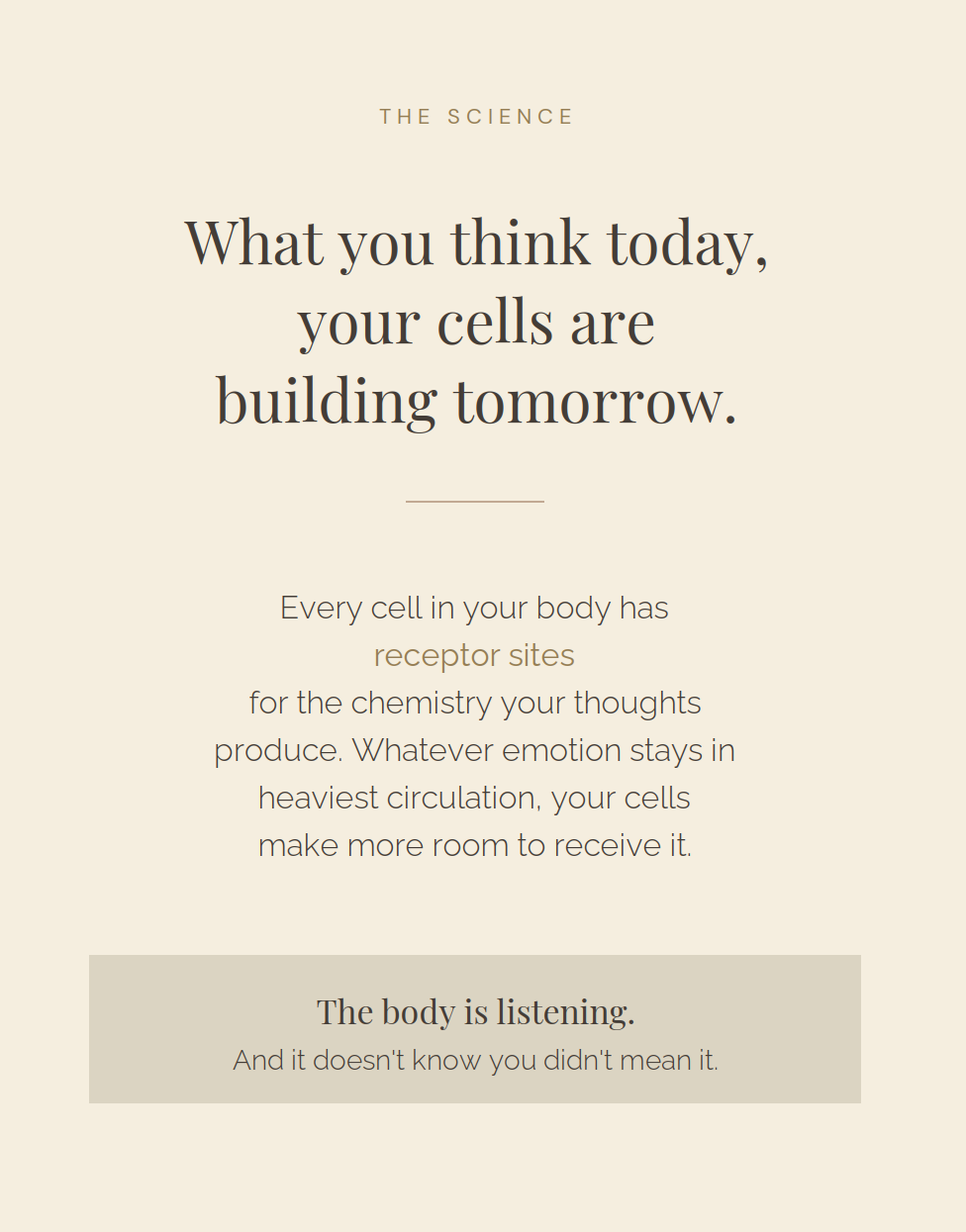
In Molecules of Emotion, neuroscientist Candace Pert documented something that still hasn’t fully made it into mainstream medicine: cells throughout your body have receptor sites for the neuropeptides your brain produces in response to your thoughts. When you ruminate on a worry, your hypothalamus releases a specific chemical signature; that signature travels through your bloodstream and docks onto receptors in your gut, your heart, your immune cells. Your cells don’t just react to your thoughts; they expect them. Over time, they recalibrate their sensitivity to the emotions in heaviest circulation.
Siddhartha Mukherjee writes about something adjacent in The Song of the Cell: that the cell is not a passive bag of chemistry but a listening, responsive, communicating unit. Cells talk to each other. They remember. They adapt to the environment you give them, and the environment includes your inner monologue.
This is why a person who has lived in chronic anxiety for twenty years can’t simply decide one morning to feel calm. Their nervous system has spent two decades accommodating that signal: adjusting receptor sensitivity, recalibrating the HPA axis, reshaping vagal tone, and remodeling the architecture of the stress response itself. The body is brilliant; it adapts to meet the demand it anticipates is coming. But as I wrote about in my reflection on fasting and allostatic overload, that same adaptive intelligence carries a cost when the demand never stops. The cells that adapted to stress will also adapt to safety; they just need new information, consistently enough, to predict a different future.
Which is exactly why success mindset is not a soft pillar of the DESTRESS framework. It is not positive thinking dressed up as biology; it is biology. What you think today, your cells are building tomorrow.
The quantum piece, without the woo
I want to be careful here, because “quantum” has become a marketing word, and most of what gets sold under that banner is not science.
What the actual physics says is this: at the subatomic level, the act of observation influences the behavior of what’s being observed. The double-slit experiment, replicated countless times since the early 1900s, shows that particles behave differently depending on whether they’re measured. We don’t fully understand why. We’ve understood the that for a hundred years and the why is still genuinely contested.
Dr. Joe Dispenza has spent his career trying to bridge this finding into the human nervous system; his work draws on neuroplasticity, HRV research, and meditation studies, and some of his peer-reviewed work on group meditation and immune function is worth reading. I don’t follow him into every claim he makes, and I’d gently note that some of the science is more settled than other parts. What I do take from his work — and from the broader field — is the idea that attention shapes experience at a level we haven’t fully mapped yet. Where you put your focus is not neutral.
Attitude is upstream of emotion (sometimes)

Amy Cuddy's research suggests an open, expansive posture can shift how powerful you feel.
From a practical standpoint, the body can lead the mind more often than we give it credit for.
Amy Cuddy’s research on how an open, expansive posture can shift how powerful you feel, Paul Ekman’s work on facial feedback (smile, even artificially, and your mood often follows), Stephen Porges’s polyvagal theory on how vagal tone shapes emotional state, all point in the same direction. Embodiment precedes belief. Stand tall before you feel confident; breathe slow before you feel calm; choose a generous interpretation before you feel generous. The nervous system is not a one-way street from feeling to behavior. It’s a loop.
I’ll be honest about the state of this research, because I’d rather you trust me than oversell it. The most famous version of it, Amy Cuddy’s “power posing,” didn’t fully hold up: her own co-author later said she no longer believed the original effects were real, and independent labs couldn't replicate the hormonal changes the study reported. What survived the scrutiny was the quieter, sturdier claim that posture, breath, and expression do feed back into how you feel. The size of the effect is gentler than a TED talk implies; the direction is real.
So here’s my honest invitation: try it yourself. Stand tall before your next hard conversation. Soften your shoulders and slow your exhale when you feel the spin starting. I feel a difference when I do, every time. The studies can argue about the averages; what you feel in your own body is the data that actually counts.
This is the part of “fake it till you make it” that holds up under scrutiny. Not the performative version, where you paste on a smile and pretend nothing is wrong. The embodied version, where you give your body a different input and let your biology catch up.
A word for anyone in the thick of it

If you are in a season of clinical depression, complex trauma, postpartum collapse, or any of the genuinely physiological mental illnesses, none of this is a prescription for you to think your way out, sincerely.
Severe mental illness is a body state too, involving inflammation, mitochondrial dysfunction, HPA axis dysregulation, trauma held in tissue, and sometimes genetic polymorphisms that affect how you process neurotransmitters. Telling someone in that state to “just choose better thoughts” is not only ineffective; it’s a kind of cruelty I want no part of. Success mindset is a tool for the relatively well. For the unwell, it is one piece of a much larger puzzle that includes skilled practitioners, somatic work, and often medical support.
And here is the part I want you to hear most: that puzzle is real, and increasingly well-mapped. The body and mind can heal in extraordinary ways with the right team around you. I have watched it happen. You may not believe that yet, and you don’t have to; belief tends to come after the first signs of relief, not before. If you are in a hole so deep you can’t see a way out, please don’t carry this post as one more weight. Come back to it when you’re ready. There is a path, and you are not alone on it.
For everyone else: the work is real, and it’s available.
What this looks like in a body
For many of the women I work with, the loudest signal isn’t external; it’s internal. “I’m not satisfied with my body.” “I’m so stressed out.” “I’m not enough.” Said often enough, these aren’t passing thoughts. They become the biochemical environment our cells are organizing around. The body is listening, and it doesn’t know you didn’t mean it.
In my own life, success mindset is less about visualizing outcomes and more about which frequency I’m broadcasting to my own cells on an average Tuesday. Am I building neural pathways for gratitude or for grievance? Am I rehearsing peace or rehearsing panic? When something goes sideways: a contractor doesn’t show up, a test result comes back ambiguous, a fast gets harder than I expected, what is the story I am feeding the cells that are listening?
The success I’m after isn’t a destination; it’s a frequency. Your cells are listening, and they are accommodating. Whatever they hear most, they become.
In the next post, we’ll move into Supplements. I used to think they belonged at the end of the framework, almost as an afterthought. I no longer believe that, and I’ll tell you why.
*The DESTRESS Protocol™ referenced in this series was developed by Dr. Stephen Cabral and is taught in his Integrative Health Practitioner certification. I'm grateful for his work, and for training that gives practitioners real tools to help others heal. The interpretations and applications here are my own.