
When the Fast Doesn't Land the Way It's Supposed To

What my last fast reminded me about the nervous system, the science of stress, and the state your body has to be in to actually heal.
I attended a fasting retreat earlier this month. It didn't go the way I expected.
I've done this work for years. I know my body's pattern: easing in on day one, a hard day two, and then the turn. By day three I'm usually clear-headed in a way that's hard to describe to anyone who hasn't felt it. A lightness and energy in the body. A mental clarity and heightened creativity that no amount of sleep or coffee can produce; something you can't access any other way. It feels like coming home to myself; like meeting the version of me that existed before modern life started asking so much of my body. The way a kid feels when they're truly free in mind, body, and spirit. That's how I know the fast is working.
This time, I never got home. I suffered throughout. I track my biomarkers carefully during a fast, and that aspect was no different; the data told a story of a body responding correctly. But my felt experience told a different story entirely. My body was working hard, and it didn't feel good.
After the fast, I sat with it. There were external factors I could point to: an air quality issue serious enough that I needed a room change in the middle of the night on day two, and a few other things that didn't go as planned. Each of those mattered. But underneath all of them was something I hadn't fully reckoned with before I went.
I arrived already depleted.
The state I was in before I started
The months before the fast had been a lot. An active construction project I live inside of. A business I'm building from the studs up. Two training programs running in parallel. Taxes. Life. Travel. None of it dramatic on its own; all of it stacked.
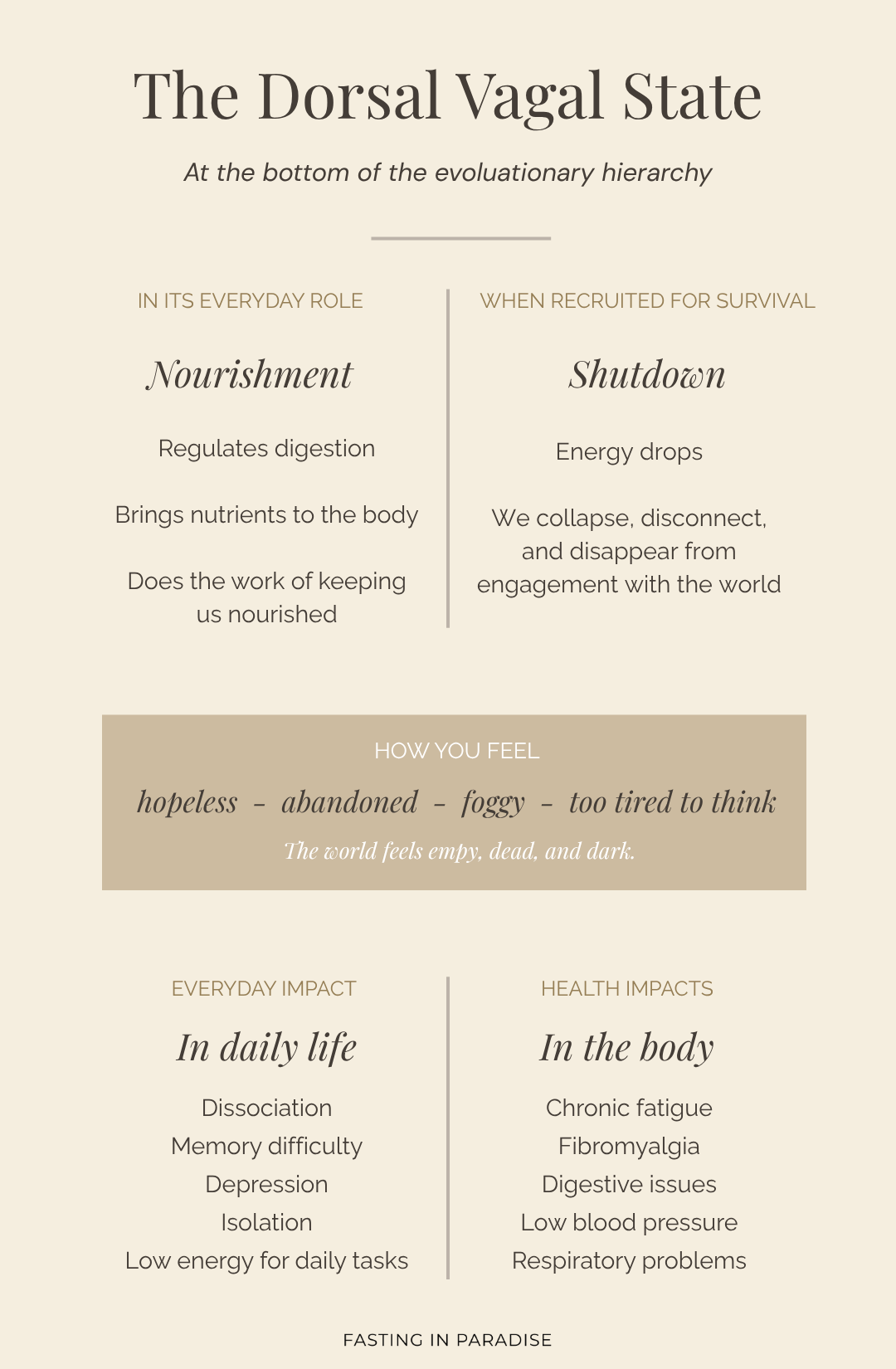
In Polyvagal terms, I had moved into what's called a dorsal vagal state. That's the autonomic nervous system's conservation mode; the place the body goes when sympathetic activation can't be sustained any longer and the system drops into shutdown. It doesn't always look like collapse from the outside. Sometimes it looks like getting things done. Sometimes it looks like me, packing a suitcase for a fasting retreat because I decided that I desperately need a break.
I knew I needed rest. I conflated rest with a fast. And those are not the same thing.
Why the body in dorsal vagal can't fast the way a regulated body can
Fasting is a hormetic stressor. That's the scientific term for a stress that's mild enough, applied at the right dose, to make the body more resilient as it adapts to it. Exercise is hormetic. Cold plunges are hormetic. Sauna is hormetic. The principle is the same across all of them: a recoverable challenge teaches the system to handle more — like building a muscle.
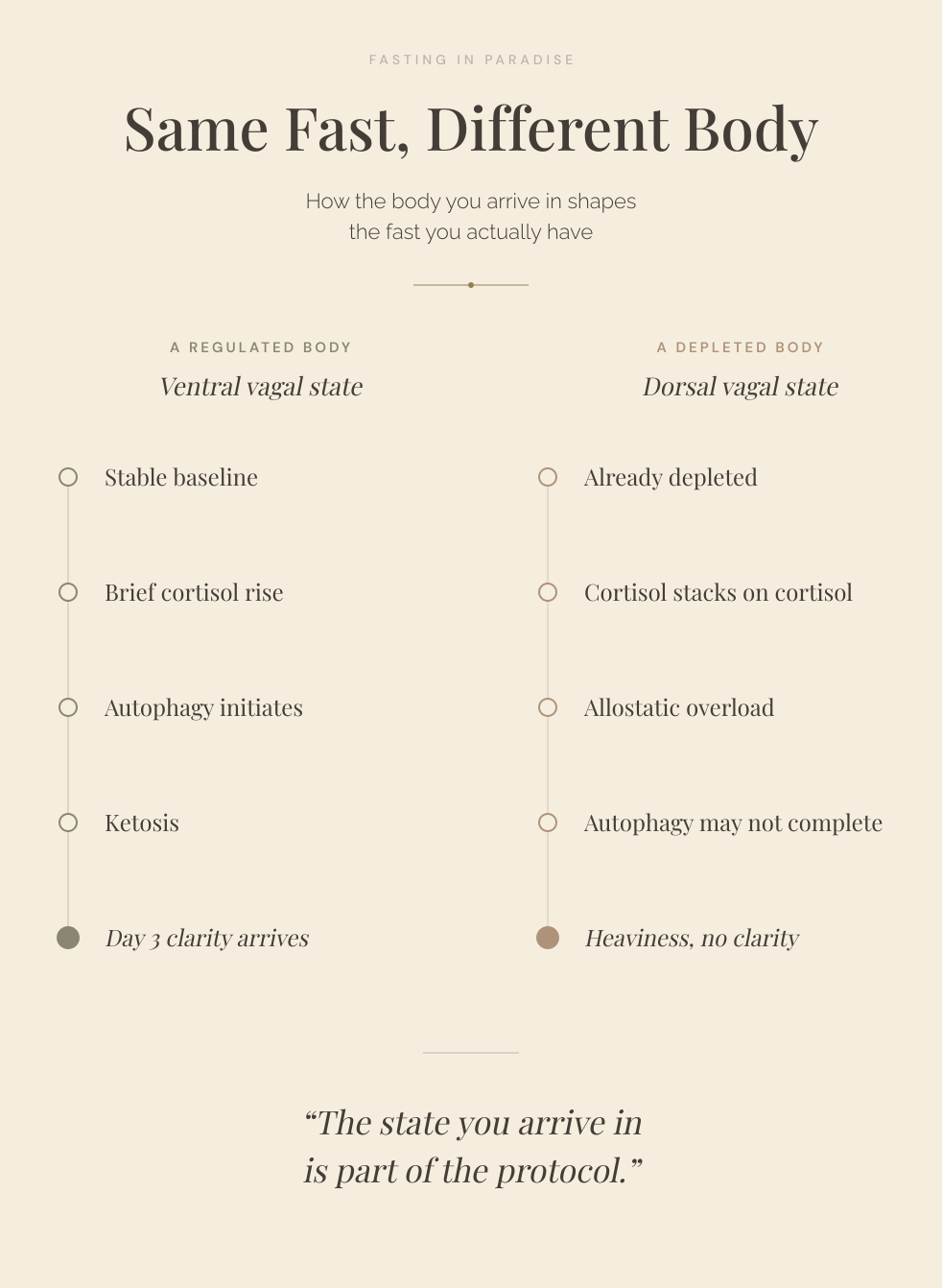
Hormesis only works when the body has the resources to meet the challenge. When the baseline is already stable, a fast activates a beautiful cascade: cortisol rises briefly to mobilize stored energy, autophagy turns on, the body shifts into ketosis, and the cellular cleanup that makes fasting so powerful gets underway. That's the day three feeling. That's the clarity arriving.
When the baseline is not stable, the same fast becomes something else entirely. The cortisol that rose briefly to support the fast stacks on top of cortisol that's already been chronically elevated. The system that was supposed to adapt is already running at the edge of what it can manage. There's a name for this too: allostatic load. It's the cumulative cost of carrying chronic stress, and it's measured in exactly the systems a fast asks to work harder; the HPA axis, the autonomic nervous system, the inflammatory pathways, the metabolic mediators.
When allostatic load is high enough that the body can't meet a new stressor, researchers call it allostatic overload. That's the line between productive stress and depleting stress. It's also, I think, the line I crossed before I ever got in the car.
The biomarkers don't tell the whole story
This is the part I want women to hear, because I think it gets missed in a culture that worships data.
My numbers looked good throughout the fast. Blood pressure normal. Oxygen saturation strong. Glucose stable. Ketones climbing the way they should. If I had only looked at the data, I would have told myself I was fine and pushed through. The data wasn't lying. It was telling me that my body was successfully maintaining homeostasis under load. What it couldn't tell me was the cost of that maintenance.
This is the distinction between allostasis and allostatic load. Allostasis is the active work of staying stable; the cardiovascular, neuroendocrine, autonomic, and immune systems all coordinating to keep you upright through a challenge. Allostatic load is what that work costs over time. A body in allostatic overload can hold its numbers steady and still be paying a price you can feel before you can measure.
My subjective experience was the data my biomarkers couldn't show me. The heaviness, the lack of clarity, the absence of the day three turn; those weren't signs that the protocol was wrong or my body was weak. They were signs that my system was working hard to compensate for a starting state it shouldn't have been asked to start from.
And the data couldn't have shown me what I was fasting for anyway
Here is something I have been sitting with since I came home. The deeper reason I fast is autophagy; the cellular cleanup process where the body breaks down damaged proteins and organelles and recycles them into something useful, or takes out the trash entirely. Autophagy is the long game. It's the part of fasting that earns the rest of the work.
And it cannot be measured in a living body. There is no glucose monitor for autophagy. There is no wearable, no blood test, no metric you can show your doctor. The markers researchers use require tissue biopsies. What we have in the consumer world are proxies; ketone levels, time fasted, the glucose-ketone index. Those proxies tell us the conditions for autophagy are present. They do not tell us autophagy is happening, and they certainly don't tell us if its cycle is completing.
This matters because chronic stress can impair autophagy at exactly the step where it most needs to finish. Research on stress-level cortisol shows that chronically elevated glucocorticoids disrupt autophagy flux; the cellular cleanup can get initiated and then fail to complete. Translation: the body starts the work and never quite gets to the part where the broken down pieces are actually recycled or cleared out.
It is biologically plausible that the autophagy I was fasting to achieve was impaired before I ever stopped eating. I will never know for certain. And that uncertainty is part of the lesson too. The data I had access to could not have shown me whether the deepest goal of the fast was being met. My felt experience, on the other hand, was telling me something my numbers couldn't.
I am not abandoning my biomarkers. I will keep tracking them; the data has saved me from real problems more than once. What I am doing is holding them more loosely. They are one input. They are not the input.
The environment is part of the protocol; the internal environment too
I've written before about the external environment as part of the fasting protocol. The air you breathe matters. The water you drink matters. The materials in the room matter, especially during a fast, when your body is mobilizing toxins from fat stores and asking your liver and kidneys to clear them. The air quality issue I encountered on night one of my fast was a vivid reminder that even a single environmental input can derail a process this delicate.
What this fast reminded me is that the internal environment is part of the protocol too. The nervous system state you arrive in determines what your body can do with the fast. A regulated body uses the fast to deepen healing. A depleted body uses the fast as one more demand to manage. I have known this intellectually for years; this time, I knew it in my body.
This is the piece almost no one in the fasting space is articulating. Most fasting content treats the body as a machine; input fewer calories, get autophagy. The truth is more layered. Your physiology before the fast determines your physiology during the fast. The state of your nervous system, the load you've been carrying, the chronic stressors that have shaped your baseline; those don't disappear when you stop eating. They come with you.
What I'm taking from this
I'm not sorry I went. The frameworks I have studied for years showed up in my own physiology, and there is a kind of knowing that only arrives that way. A few things are clearer now than they were before.
Rest and a fast are not the same thing. There are seasons for fasting and seasons for repairing the capacity to fast. Knowing the difference is its own discipline.
Biomarkers are a partial picture. The body has felt intelligence that precedes measurement, and a fasting woman should be taught to trust both her data and her experience. When those two diverge, the experience is often the earlier signal.
The state you arrive in matters as much as the protocol you follow. A fast started from a regulated nervous system is a different physiological event than the same fast started from depletion. The container around the fast; the days before, the space you arrive into, the way your nervous system is held during the transition; is not separate from the fast. It is the fast.
That last one is shaping how I think about Fasting in Paradise now. Part of what we're building is not just a beautifully constructed retreat with clean air and low EMF and circadian lighting. It's a deliberate downshift into ventral vagal that begins before guests arrive and continues through the threshold into the fast itself. The pre-fast protocol matters as much as the fast itself; the threshold isn't filler, it's the part that determines whether the rest of the week is healing or not.
The body knows. It always knows. My job is to keep listening.
Thank you to Deb Dana. Her work on polyvagal-informed practice has been the bridge between what I knew academically and what I now know in my body.